
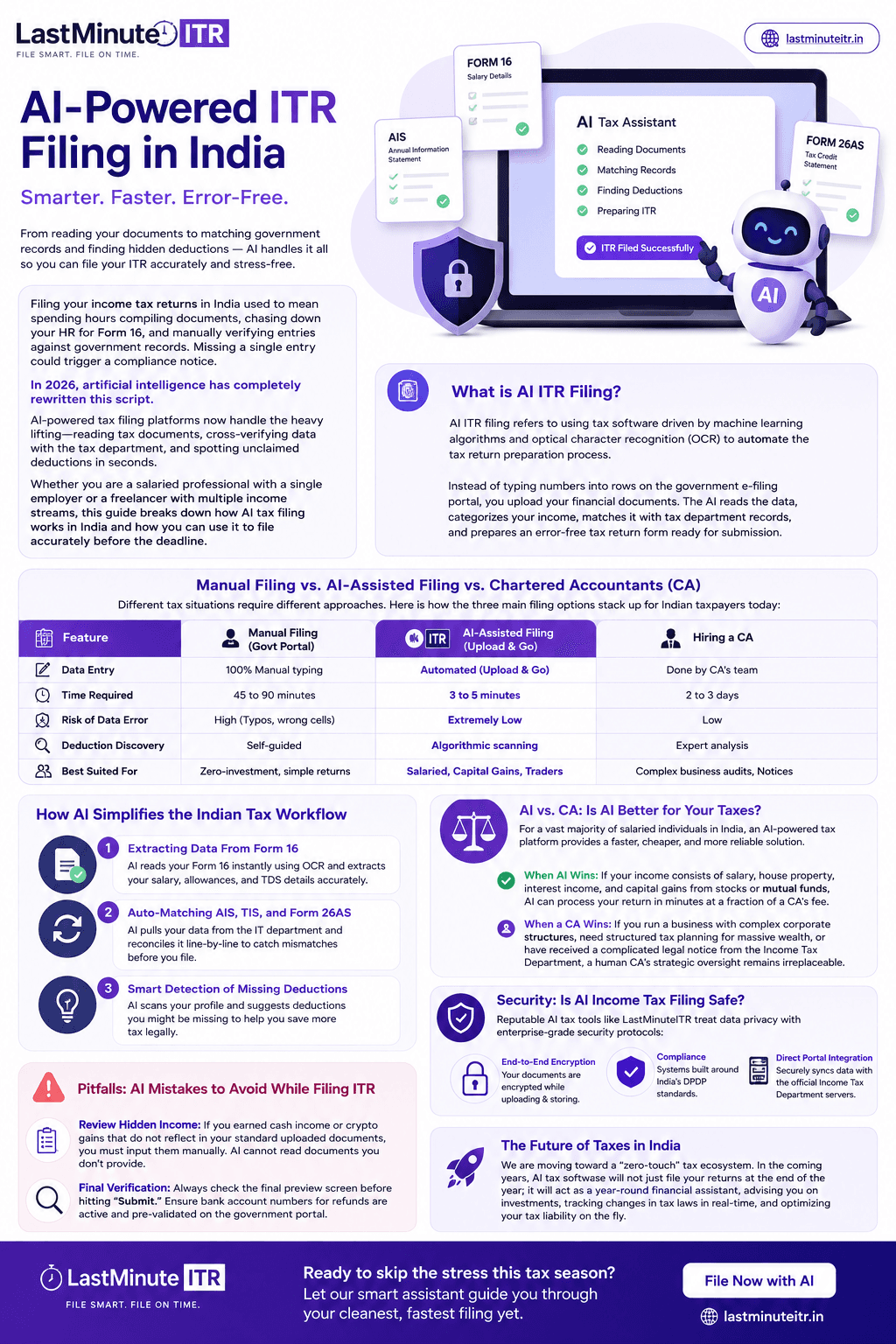

Filing your income tax returns in India used to mean spending hours compiling documents, chasing down your HR for Form 16, and manually verifying entries against government records. Missing a single entry could trigger a compliance notice.
In 2026, artificial intelligence has completely rewritten this script. AI-powered tax filing platforms now handle the heavy lifting—reading tax documents, cross-verifying data with the tax department, and spotting unclaimed deductions in seconds.
Whether you are a salaried professional with a single employer or a freelancer with multiple income streams, this guide breaks down how AI tax filing works in India and how you can use it to file accurately before the deadline.
What is AI ITR Filing?
AI ITR filing refers to using tax software driven by machine learning algorithms and optical character recognition (OCR) to automate the tax return preparation process.
Instead of typing numbers into rows on the government e-filing portal, you upload your financial documents. The AI reads the data, categorizes your income, matches it with tax department records, and prepares an error-free tax return form ready for submission.
Manual Filing vs. AI-Assisted Filing vs. Chartered Accountants (CA)
Different tax situations require different approaches. Here is how the three main filing options stack up for Indian taxpayers today:
| Feature | Manual Filing (Govt Portal) | AI-Assisted Filing | Hiring a CA |
| Data Entry | 100% Manual typing | Automated (Upload & Go) | Done by CA's team |
| Time Required | 45 to 90 minutes | 3 to 5 minutes | 2 to 3 days |
| Risk of Data Error | High (Typos, wrong cells) | Extremely Low | Low |
| Deduction Discovery | Self-guided | Algorithmic scanning | Expert analysis |
| Best Suited For | Zero-investment, simple returns | Salaried, Capital Gains, Traders | Complex business audits, Notices |
How AI Simplifies the Indian Tax Workflow
1. Extracting Data From Form 16
The old way required you to open your PDF Form 16 and manually copy numbers from Part A and Part B into your tax form. AI tax tools use advanced OCR to read your Form 16 instantly. It accurately extracts your gross salary, exempted allowances (like HRA or LTA), and tax deducted at source (TDS), mapping them perfectly to the corresponding fields in ITR-1 or ITR-2.
2. Auto-Matching AIS, TIS, and Form 26AS
The biggest cause of income tax notices in India is a mismatch between what you report and what appears in your Annual Information Statement (AIS) or Form 26AS.
AI tax assistants pull your live data from the IT department’s API and run an automated line-by-line reconciliation. If your bank reported fixed deposit interest that you forgot about, the AI flags it before you file, keeping you safe from penalties.
3. Smart Detection of Missing Deductions
Are you maximizing your tax savings under the old or new tax regime? An AI tax engine acts as a continuous scanner. It looks at your income profile, historical filings, and financial data to prompt you about deductions you might have overlooked—whether it's preventative health checkups under Section 80D or specific savings clauses.
AI vs. CA: Is AI Better for Your Taxes?
For a vast majority of salaried individuals in India, an AI-powered tax platform provides a faster, cheaper, and more reliable solution than a traditional CA.
- When AI Wins: If your income consists of salary, house property, interest income, and capital gains from stocks or mutual funds, AI can process your return in minutes at a fraction of a CA's fee.
- When a CA Wins: If you run a business with complex corporate structures, need structured tax planning for massive wealth, or have received a complicated legal notice from the Income Tax Department, a human CA’s strategic oversight remains irreplaceable.
Security: Is AI Income Tax Filing Safe?
Data security is a legitimate concern when dealing with PAN, Aadhaar, and bank details. Reputable AI tax tools like LastMinuteITR treat data privacy with enterprise-grade security protocols:
Data Protection Standards:
- End-to-End Encryption: Your documents are encrypted both while uploading and while stored.
- Compliance: Systems are designed around India's Digital Personal Data Protection (DPDP) standards.
- Direct Portal Integration: The AI compiles your data and securely syncs it with the official Income Tax Department servers without manual interference.
Pitfalls: AI Mistakes to Avoid While Filing ITR
While AI eliminates human calculations and data entry errors, it is only as good as the information it receives. To ensure a smooth filing experience, keep these pointers in mind:
- Review Hidden Income: If you earned cash income or crypto gains that do not reflect in your standard uploaded documents, you must input them manually. AI cannot read documents you don't provide.
- Final Verification: Always check the final preview screen before hitting "Submit." Ensure bank account numbers for refunds are active and pre-validated on the government portal.
The Future of Taxes in India
We are moving toward a "zero-touch" tax ecosystem. In the coming years, AI tax software will not just file your returns at the end of the year; it will act as a year-round financial assistant, advising you on investments, tracking changes in tax laws in real-time, and optimizing your tax liability on the fly.
Ready to skip the stress this tax season? Let our smart assistant guide you through your cleanest, fastest filing yet.
start filing now : lastminuteitr.in