
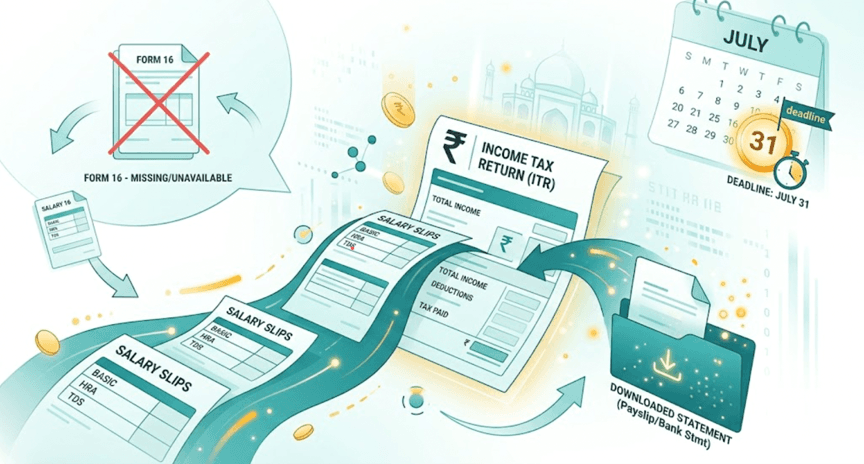

Missed the HR Deadline? Don't Panic
Every January, HR departments send frantic emails asking for investment proofs and rent receipts. If you missed the deadline, your employer calculated your TDS without giving you the House Rent Allowance (HRA) exemption.
This means your Form 16 shows a higher taxable income, and you probably paid excess tax.
The good news is that you can still claim your HRA exemption directly while filing your ITR and get that excess tax back as a refund. Here is how.
Note: HRA exemption is only available if you opt for the Old Tax Regime.
Step 1: Calculate Your HRA Exemption
The income tax portal won't calculate this for you; you have to enter the exact exempt amount. The exemption is the lowest of these three:
- Actual HRA received from your employer (check your payslips).
- Actual rent paid minus 10% of your basic salary.
- 50% of basic salary (if living in a metro city) or 40% of basic salary (non-metro).
Step 2: Adjust Your Form 16 Numbers
When you start filing your ITR, the portal will pre-fill your salary details from your employer's data.
- You will see your Gross Salary.
- Under the "Allowances exempt u/s 10" section, select "10(13A) - Allowance to meet expenditure incurred on house rent".
- Enter the exempt amount you calculated in Step 1.
The portal will automatically subtract this from your gross salary, lowering your taxable income.
Step 3: Claim Your Refund
Because your taxable income is now lower than what your employer calculated, your total tax liability will decrease. Since your employer already deducted higher TDS, the difference will be shown as a Refund Due when you complete your ITR.
Keep Your Proofs Ready
While you don't attach rent receipts to your ITR, claiming HRA directly often triggers a verification check by the tax department. Ensure you have:
- A valid rent agreement.
- Rent receipts or bank statements showing rent transfers.
- The landlord's PAN (mandatory if annual rent exceeds ₹1,00,000).
The metro vs non-metro difference
The third cap in the HRA formula depends on where you live. HRA is the House Rent Allowance your employer pays toward rent; the exempt slice is the lowest of the three tests.
| City type | Salary-based cap on HRA | Examples |
| Metro | 50% of basic salary | Delhi, Mumbai, Kolkata, Chennai |
| Non-metro | 40% of basic salary | Pune, Bengaluru, Jaipur, all others |
Landlord PAN is mandatory once annual rent crosses Rs 1,00,000, and only metro cities get the 50% cap. Source: Income Tax Act Section 10(13A) read with Rule 2A.
What you should do
- Pick the lowest of the three HRA amounts as your exemption
- Enter it under "10(13A)" in the exempt-allowances section while filing the old regime
- Keep the rent agreement, receipts and landlord PAN ready in case of a query
Common mistake
Claiming HRA in the new regime. The HRA exemption only exists under the old regime, so a new-regime filer who enters it gains nothing and risks a mismatch.
Make It Easier with LastMinute ITR
Calculating HRA manually can be tricky. When you use LastMinute ITR, you can simply input your rent paid and city type. We will calculate the exact exemption according to the rules and show you how much refund you can expect under the old regime.
Start your tax calculation to see your potential HRA refund.
Frequently asked questions
Can I claim HRA directly in my ITR if it's not in my Form 16?
Yes, you can claim the HRA exemption directly while filing your ITR under the old tax regime, even if your employer didn't factor it into your Form 16.
Do I need to upload rent receipts while filing ITR?
No, you don't upload documents while filing. However, you must keep the rent agreement, receipts, and landlord's PAN (if rent > ₹1 lakh/year) safe in case of a tax notice.