
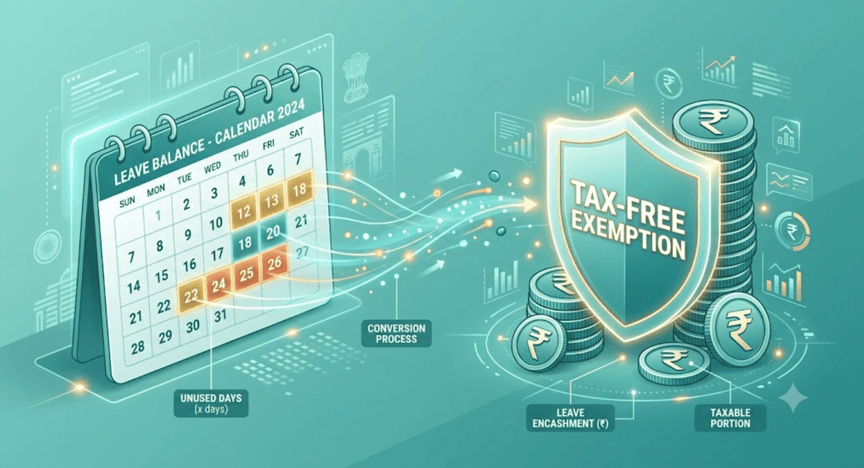

Cashing In Your Leaves: The Tax Impact
Many companies allow employees to carry forward unused earned leaves and "encash" them—either during their employment or when they leave the company.
While getting extra cash is great, the taxman treats this money differently depending on when you receive it and who you work for.
1. Encashment During Employment (Fully Taxable)
If you decide to encash your accumulated leaves while you are still actively working for the company, the entire amount is fully taxable.
It is added to your gross salary and taxed according to your applicable slab rate. There are no exemptions available for this, whether you are a government or a private sector employee.
2. Encashment at Retirement or Resignation
The rules change favorably when you receive leave encashment at the time of leaving the company (resignation, retirement, or termination).
For Government Employees
If you are a Central or State Government employee, the entire leave encashment amount received at retirement or resignation is fully exempt from tax under Section 10(10AA)(i).
For Non-Government (Private) Employees
If you work in the private sector, the exemption is calculated as the lowest of the following four amounts:
- The actual amount of leave encashment received.
- The maximum limit set by the government (currently ₹25 lakhs for retirements/resignations after April 1, 2023).
- 10 months' average salary (based on the average salary of the last 10 months preceding retirement/resignation).
- Cash equivalent of unavailed leaves (calculated based on a maximum of 30 days of leave per year of actual service).
Note: The ₹25 lakh limit is a lifetime limit. If you claimed an exemption of ₹5 lakhs when leaving a previous job, you only have ₹20 lakhs of exemption limit remaining for future job changes.
The lifetime exemption for non-government leave encashment was raised eightfold, from Rs 3,00,000 to Rs 25,00,000, with effect from 1 April 2023. Source: CBDT Notification No. 31/2023; Income Tax Act Section 10(10AA).
How to Report it in Your ITR
If you received leave encashment upon resigning, your employer will usually calculate the exempt portion and report it in Part B of your Form 16 under "Allowances exempt u/s 10".
When filing your ITR:
- The fully taxable portion will be included in your Gross Salary.
- The exempt portion must be declared under the Section 10 exemptions list.
What you should do
- Check whether the encashment was during service (fully taxable) or on exit (partly exempt)
- For private exits, take the lowest of the four tests as your exempt amount
- Track how much of the Rs 25,00,000 lifetime cap you have already used across past jobs
- Match the taxable and exempt split against your Form 16 before filing
Common mistake
Treating in-service encashment as exempt. Only encashment at retirement or resignation qualifies; cashing leave while still employed is fully taxable salary.
If you are using LastMinute ITR, you don't need to worry about entering these details manually. Just upload your Form 16, and our system will automatically extract the exempt leave encashment and place it in the correct schedule for your tax return.
Frequently asked questions
Is leave encashment received while still working taxable?
Yes. Any leave encashment received while you are still in service is fully taxable as salary, regardless of whether you are a government or private employee.
What is the maximum tax exemption for leave encashment on resignation?
For non-government employees, the maximum lifetime exemption limit for leave encashment received at the time of resignation or retirement is ₹25,000,000 (₹25 lakhs).