
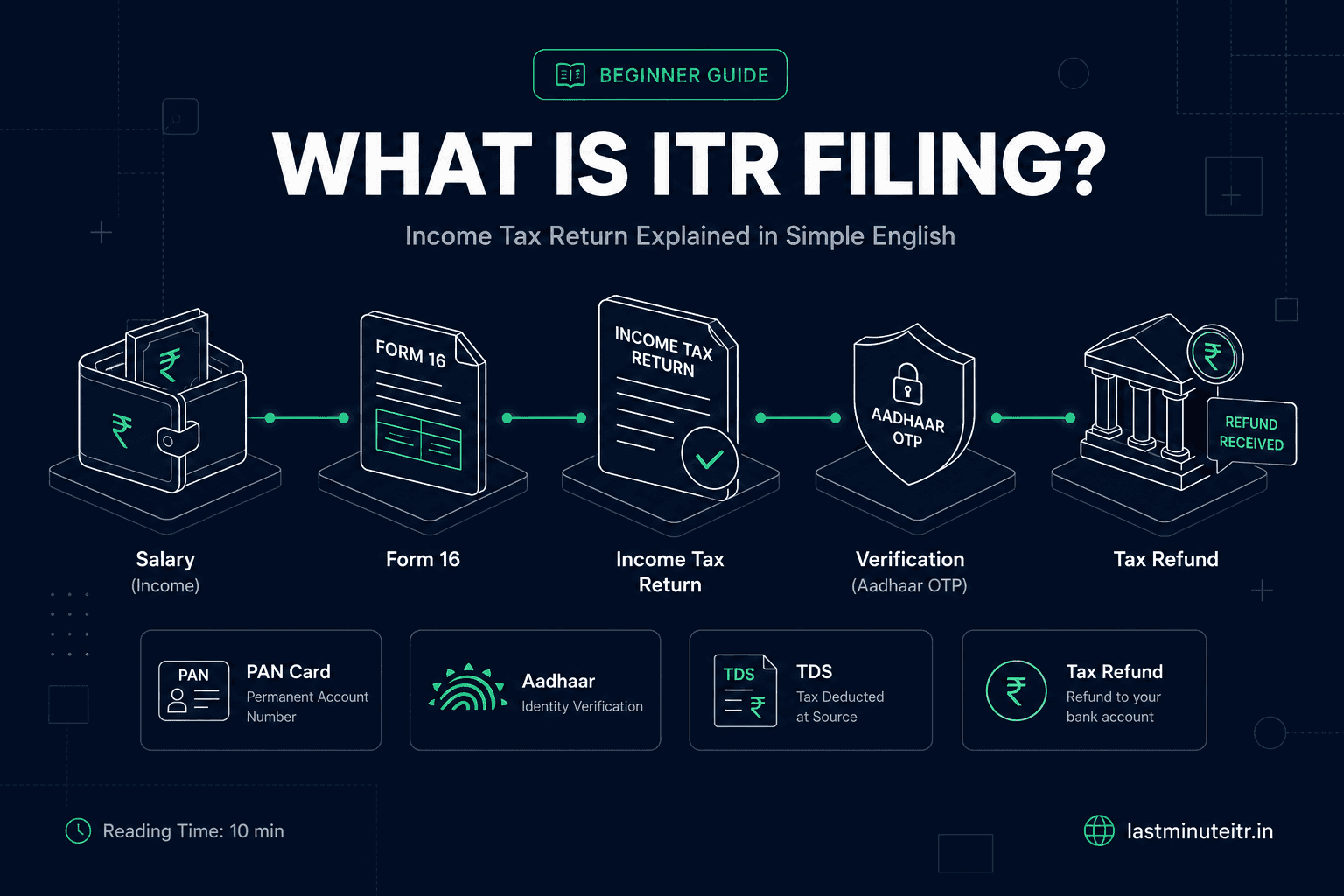

What Is ITR Filing? Income Tax Return Explained in Simple English (2026 Guide)
Most people hear the words Income Tax Return long before they actually need to file one.
It usually starts with a friend saying, "Have you filed your ITR yet?" Or maybe your employer sends you a Form 16 and suddenly you're wondering what you're supposed to do with it.
If you've landed here, chances are you're asking a simple question:
What exactly is ITR filing?
The short answer is this:
ITR filing means telling the Income Tax Department how much money you earned during a financial year, how much tax you paid, and whether you still owe tax or deserve a refund.
That's it.
But there's a little more to the story, and once you understand it, filing your Income Tax Return becomes much less intimidating.
Whether you're a salaried employee, a freelancer, a business owner, or someone earning their first internship stipend, this guide will help you understand the complete process in plain English.
Quick Summary
| Question Answer | |
| What is ITR? | A statement of your income, taxes paid, deductions claimed, and tax liability. |
| Who files it? | Salaried employees, freelancers, business owners, professionals, and others based on income and eligibility. |
| Is filing the same as paying tax? | No. Filing and paying tax are two different things. |
| Can I get a refund? | Yes. If you've paid more tax than required, the government refunds the excess amount. |
| Is it online? | Yes. Most taxpayers file their ITR online through the Income Tax portal. |
What Is ITR Filing?
Let's begin with the basics.
An Income Tax Return (ITR) is a form you submit to the Income Tax Department of India. It contains details such as:
- Your income
- Tax deducted by your employer
- Tax you've paid yourself (if any)
- Investments and deductions you're claiming
- The final amount of tax payable—or refundable
Think of it like an annual financial report card.
Instead of your school grading your performance, you're giving the tax department a summary of your financial year.
Here's a simple example.
Suppose Rahul works at an IT company in Bengaluru and earns ₹8 lakh a year.
Every month, his employer deducts some tax from his salary as TDS (Tax Deducted at Source).
At the end of the financial year, Rahul files his Income Tax Return.
During filing, he declares:
- His salary
- The tax already deducted
- His investments under eligible tax-saving sections
- Home loan interest (if applicable)
- Any bank interest he earned
After everything is calculated, one of two things happens:
- Rahul may need to pay a little extra tax.
- Or he may receive a refund because extra tax was deducted during the year.
That's the purpose of ITR filing.
Did You Know?
Many first-time taxpayers think that if tax is already deducted from their salary, they don't need to file an Income Tax Return.
That's not always true.
TDS only means tax has been collected in advance. Filing your return confirms whether the correct amount of tax was paid and helps you claim any refund you're entitled to.
Why Is Income Tax Return Important?
People often think ITR filing is only about paying taxes.
Actually, that's only one part of it.
Your Income Tax Return is also a financial document that's useful in many situations outside taxation.
For example:
- Applying for a home loan
- Applying for a car loan
- Applying for an education loan
- Applying for a visa
- Showing proof of income
- Claiming a tax refund
- Carrying forward certain business or capital losses, where allowed
Imagine you're planning to buy your first apartment after a few years.
The bank asks for your last three years' Income Tax Returns.
If you've been filing regularly, the process becomes much smoother.
That's one reason many people continue filing even when they aren't legally required to.
Benefits of Filing an Income Tax Return
| Benefit Why It Matters | |
| Claim tax refunds | Recover excess tax deducted through TDS or advance tax. |
| Proof of income | Helpful for loans, visas, and financial applications. |
| Better financial record | Demonstrates consistent tax compliance. |
| Carry forward eligible losses | Certain losses can be adjusted against future income, subject to tax rules. |
| Easier financial verification | Banks and financial institutions often ask for ITRs. |
Paying Tax vs Filing ITR: They're Not the Same
This is one of the biggest misconceptions.
Let's clear it up.
Paying Tax
Paying tax simply means the government receives the amount you owe.
This may happen through:
- TDS deducted by your employer
- Advance tax
- Self-assessment tax
Money has been paid.
That's all.
Filing ITR
Filing an Income Tax Return is where you officially report:
- Your total income
- Taxes already paid
- Deductions claimed
- Final tax calculation
- Refund due (if any)
Think of paying tax as making a payment.
Think of filing an ITR as submitting the final bill showing exactly what happened.
Both are connected—but they're not the same thing.
Common Mistake
Many people assume:
"My employer deducted TDS, so my work is finished."
Not necessarily.
Depending on your income, other sources of earnings, and applicable rules, you may still need to file an Income Tax Return.
Even if you're not required to file, doing so can help you maintain a financial record and claim refunds where applicable.
Who Should File an Income Tax Return?
This is probably the question most beginners ask.
The answer depends on your income, age, residential status, and a few other conditions.
Generally, you should consider filing if you're:
- A salaried employee
- A freelancer or consultant
- A business owner
- A professional such as a doctor, lawyer, or architect
- Someone earning income from rent, investments, or capital gains
- A person who meets the filing conditions prescribed under the Income-tax Act
But here's the catch.
Even if your income is below the taxable limit, filing may still be beneficial in situations such as claiming a refund or maintaining income records.
We'll look at the detailed eligibility rules, income thresholds, exceptions, and different taxpayer categories in the next section.
Who Doesn't Need to File an Income Tax Return?
By now, you know what an Income Tax Return is and why it matters.
The next question is obvious.
Does everyone in India have to file an ITR?
Not really.
For many people, filing is mandatory. For others, it's optional but still a good idea.
Let's break it down in simple terms.
Who Is Generally Required to File an ITR?
In most cases, you should file an Income Tax Return if your total income during the financial year exceeds the basic exemption limit applicable to you under the tax regime.
But income isn't the only factor.
The Income-tax Act also specifies certain situations where a person may need to file a return even if their taxable income is below the exemption limit.
Examples may include certain high-value financial transactions or other prescribed conditions.
Since these rules can change over time, it's always worth checking the latest guidance on the Income Tax portal before filing.
Eligibility at a Glance
| Situation Should You File an ITR? | |
| Salaried employee with taxable income above the applicable exemption limit | Yes |
| Freelancer or consultant with taxable income above the applicable exemption limit | Yes |
| Business owner with taxable income above the applicable exemption limit | Yes |
| Tax refund is due | Strongly recommended |
| TDS has been deducted | Usually recommended |
| Applying for loans or visas | Recommended |
| Income below the exemption limit with no other filing requirement | May not be mandatory |
| No taxable income and no prescribed filing condition applies | Usually not required |
Expert Advice
Even if filing isn't compulsory, many taxpayers choose to file every year because it creates a clean financial history. That history can be useful when applying for loans, scholarships, visas, or insurance.
Let's Look at an Example
Meet four different taxpayers.
Priya – Software Engineer
Priya earns ₹9 lakh a year.
Her employer deducts TDS every month.
She should file an Income Tax Return to report her salary, claim eligible deductions, and check whether she's entitled to a refund.
Aman – Freelance Graphic Designer
Aman works with clients in India and abroad.
No employer deducts tax from his payments.
He's responsible for maintaining records and filing the appropriate ITR based on his income and business activity.
Meera – College Student
Meera completed a paid summer internship and earned ₹45,000.
No tax was deducted.
She has no other income.
Depending on the applicable rules for that year, filing may not be mandatory. Still, filing voluntarily can help her begin building a financial record.
Raj – Retired Professional
Raj receives pension income along with interest from fixed deposits.
Whether he needs to file depends on his total income and other applicable filing conditions.
Did You Know?
Many first-time taxpayers file an ITR simply because they want to claim a refund of tax deducted by their employer or bank.
Without filing the return, that refund usually cannot be processed.
Which ITR Form Should You Choose?
Here's where many people get confused.
You've decided to file.
Now you open the Income Tax portal and suddenly see names like:
- ITR-1
- ITR-2
- ITR-3
- ITR-4
Which one do you pick?
Choosing the wrong form can lead to problems later, including the possibility of filing a revised return if the wrong form was used.
Fortunately, selecting the correct form becomes much easier once you understand what each one is designed for.
ITR-1 (Sahaj)
This is the form most salaried employees use.
It's meant for individuals with relatively simple sources of income.
Typically, ITR-1 is used when income comes from sources such as:
- Salary or pension
- One house property (subject to conditions)
- Income from other sources like savings account interest (excluding certain categories)
There are eligibility conditions and exclusions, so it's important to confirm that your situation matches the requirements before choosing this form.
Example
Ananya works in a private company.
She earns salary income.
She has interest from her savings account.
She owns one self-occupied house.
Her income falls within the conditions applicable for ITR-1.
For many taxpayers with similar profiles, ITR-1 is the simplest option.
ITR-2
ITR-2 is generally meant for individuals and Hindu Undivided Families (HUFs) who do not have income from business or profession but have more complex income than ITR-1 allows.
Examples may include:
- Capital gains
- Income from more than one house property
- Certain foreign assets or foreign income
- Other situations where ITR-1 isn't applicable
Example
Neha works in an MNC.
Apart from salary, she sold shares during the year and earned capital gains.
Since capital gains are involved, ITR-2 may be the appropriate form instead of ITR-1.
ITR-3
ITR-3 is generally used by individuals and HUFs who have income from a business or profession.
Examples include:
- Doctors
- Lawyers
- Chartered accountants
- Consultants
- Freelancers (depending on their tax treatment)
- Proprietors
Example
Rohan runs a digital marketing agency.
His income comes from client projects rather than a salary.
He generally files ITR-3 if his income falls under the regular business or professional provisions.
ITR-4 (Sugam)
ITR-4 is designed for certain taxpayers who opt for the presumptive taxation scheme, subject to eligibility conditions.
This scheme allows eligible small businesses and professionals to declare income using simplified provisions instead of maintaining detailed books in certain cases.
Example
Sunil owns a small retail shop.
He qualifies for the presumptive taxation scheme and chooses to file under those provisions.
ITR-4 may be the right form for him.
Quick Comparison of ITR Forms
| ITR Form Best For Business Income Salary Capital Gains | ||||
| ITR-1 | Salaried individuals with simple income | ❌ | ✅ | Usually No |
| ITR-2 | Salary + capital gains, multiple house properties, certain other cases | ❌ | ✅ | ✅ |
| ITR-3 | Business owners and professionals | ✅ | ✅ (if applicable) | ✅ |
| ITR-4 | Eligible taxpayers under the presumptive taxation scheme | ✅ (Eligible cases) | ✅ | Limited eligibility |
Pro Tip
Never choose an ITR form just because a friend uses it. The correct form depends on your income sources, not your job title alone.
Common Mistakes While Choosing an ITR Form
Even experienced taxpayers make mistakes.
Here are a few to avoid:
Choosing ITR-1 despite having capital gains
Selling shares, mutual funds, or property can change which form is applicable.
Ignoring freelance income
Many salaried employees also earn from:
- YouTube
- Content writing
- Consulting
- Affiliate marketing
- Online coaching
These additional income sources can affect the appropriate ITR form.
Assuming everyone with a salary uses ITR-1
Not always.
A salaried person with capital gains or certain other income may need a different form.
Filing without reviewing pre-filled information
The Income Tax portal often provides pre-filled data based on available records.
Review it carefully instead of assuming it's complete or error-free.
Quick Summary
Choose the ITR form based on how you earn, not just how much you earn.
Salary income isn't the only factor.
Business income, professional income, capital gains, and other income sources all matter.
If you're unsure, seek professional guidance rather than guessing.
Documents Required Before You File Your ITR
One of the biggest reasons people get stuck while filing their Income Tax Return is simple—they start too early.
Not because they're eager.
Because they don't have the right documents.
A few missing details can mean pausing the process halfway, logging out, and promising yourself you'll "finish it tomorrow."
That tomorrow often turns into the filing deadline.
The good news? You don't need a huge stack of paperwork. For most taxpayers, a handful of documents is enough.
Let's go through them one by one.
Document Checklist
| Document Why You Need It Mandatory? | ||
| PAN Card | Identifies you as a taxpayer | Yes |
| Aadhaar Card | Identity verification and e-verification | Usually required |
| Form 16 | Salary and TDS details | For salaried employees |
| AIS (Annual Information Statement) | Shows income and financial transactions | Recommended |
| Form 26AS | Confirms taxes credited to your PAN | Recommended |
| Bank Account Details | Refund credit and verification | Yes |
| Investment Proofs | Claim eligible deductions | If applicable |
| Home Loan Certificate | Claim eligible benefits | If applicable |
| Capital Gains Statement | Report investment gains or losses | If applicable |
| Business Records | Business or professional income | If applicable |
Quick Tip
Create a folder on your laptop or phone named "ITR 2026" and keep all these documents together. You'll thank yourself later.
1. PAN Card
Your Permanent Account Number (PAN) is the foundation of your tax profile.
Every tax-related activity in India is linked to this number.
When you file an Income Tax Return, the system uses your PAN to match:
- Salary details
- TDS
- Bank interest
- Investment income
- Previous ITRs
- Tax refunds
Without the correct PAN, your return may not be processed correctly.
Before filing, double-check:
- Name spelling
- Date of birth
- PAN number
Even a small typing mistake can delay processing.
2. Aadhaar Card
Your Aadhaar isn't just another identity document.
It's commonly used during the verification stage after submitting your return.
Many taxpayers complete e-verification using an Aadhaar-linked OTP, making the process quick and paperless.
Before filing:
- Ensure your mobile number is linked with Aadhaar.
- Verify that your Aadhaar details match your PAN records.
If there is a mismatch in basic details like your name or date of birth, resolve it before filing.
Common Mistake
Many people submit their return but forget to complete the verification step.
An unverified return is generally treated as not fully filed, so always finish the verification process within the prescribed time.
3. Form 16
If you're a salaried employee, Form 16 is probably the most familiar document you'll receive from your employer.
Think of it as your salary tax summary.
It typically contains:
- Total salary paid
- Tax deducted at source (TDS)
- Exemptions and allowances
- Taxable income
- Employer details
- PAN and TAN information
You don't upload Form 16 while filing in every case, but the information inside it helps you complete your return accurately.
Example
Riya earns ₹8.5 lakh annually.
Her employer deducts TDS every month.
Instead of calculating everything manually, she refers to Form 16 and enters the required details into her ITR.
It saves time and reduces mistakes.
Internal Link Placeholder
Read our complete guide on Form 16.
4. AIS (Annual Information Statement)
Here's something many people don't realize.
Your salary isn't the only income the Income Tax Department can see.
The Annual Information Statement (AIS) provides a broader picture of your financial activities.
Depending on your records, it may include information such as:
- Salary
- Savings account interest
- Fixed deposit interest
- Dividend income
- Securities transactions
- Mutual fund transactions
- High-value financial transactions
- Tax payments
AIS helps you ensure that you haven't accidentally forgotten to report any income.
Why It Matters
Imagine you earned:
- ₹12,000 interest from a fixed deposit
- ₹8,000 dividend income
- ₹20,000 from selling mutual funds
You might forget about one of these.
AIS serves as a useful cross-check before you submit your return.
Internal Link Placeholder
Learn more about AIS and how to read it.
5. Form 26AS
People often confuse AIS and Form 26AS.
They're related, but they aren't the same.
Form 26AS primarily acts as your tax credit statement.
It helps confirm whether taxes deducted or collected in your name have actually been credited against your PAN.
You'll commonly find:
- TDS deducted by employers
- TDS deducted by banks
- Advance tax
- Self-assessment tax
- Certain other tax credits
Before filing, compare the tax figures in Form 16 with Form 26AS.
If something looks different, it's worth checking before submitting your return.
Did You Know?
One of the most common reasons for delayed refunds is a mismatch between the information reported in the return and the tax credits reflected in official records.
Taking a few extra minutes to review your documents can save weeks of follow-up later.
6. Bank Account Details
Your refund needs somewhere to go.
That's why you'll be asked to provide or confirm your bank account details.
Before filing, verify:
- Account number
- IFSC code
- Bank name
- Account status (active)
Many taxpayers maintain multiple accounts.
If so, make sure the account selected for refunds is active and correctly validated on the Income Tax portal.
7. Investment Proofs
If you've invested in eligible tax-saving options, keep the supporting documents ready.
Examples may include:
- Life insurance premium receipts
- Public Provident Fund (PPF) contributions
- Employee Provident Fund (EPF) details
- ELSS mutual fund investments
- Tuition fee receipts (where eligible)
- Home loan documents
- Health insurance premium receipts
These documents help support any deductions you're eligible to claim under the applicable tax provisions.
8. Capital Gains Statement
If you've sold:
- Shares
- Mutual funds
- Property
- Gold
- Other capital assets
you'll usually need a statement showing:
- Purchase price
- Sale price
- Dates of purchase and sale
- Gain or loss
This information is essential for reporting capital gains correctly.
9. Business or Freelance Records
If you're self-employed, don't rely on memory.
Maintain records of:
- Invoices
- Business expenses
- Client payments
- GST records (if applicable)
- Bank statements
- Accounting reports
Good record-keeping makes ITR filing much easier and helps if clarification is ever needed later.
Step-by-Step ITR Filing Process
Now that your documents are ready, let's walk through the filing process.
Step 1 – Gather Your Documents
Collect everything from the checklist above.
Don't begin until you're reasonably confident you have all the required information.
Step 2 – Log In to the Income Tax Portal
Access your account using your PAN and password.
If you're a first-time user, complete the registration process.
Step 3 – Select the Correct Assessment Year and ITR Form
Choose the relevant assessment year and the ITR form that matches your income sources.
If you're unsure, don't guess.
Review the eligibility criteria or seek professional guidance.
Step 4 – Review Pre-Filled Information
The portal often auto-populates available information.
Review every section carefully.
Don't assume pre-filled means perfect.
Step 5 – Add Missing Income
Include any income that's not already reflected, such as:
- Interest income
- Rental income
- Freelance income
- Capital gains
- Other taxable income
Step 6 – Claim Eligible Deductions
Enter deductions and exemptions that apply to you based on the current tax rules and the regime you've chosen.
Step 7 – Verify Tax Liability
The system calculates:
- Total income
- Tax payable
- Taxes already paid
- Balance payable or refund due
Review everything before moving ahead.
Step 8 – Submit Your Return
Once you're satisfied, submit the Income Tax Return.
But don't stop there.
Step 9 – Complete E-Verification
This is the final step.
You can verify your return using one of the available methods, such as an Aadhaar OTP or other options provided on the Income Tax portal.
Only after successful verification is your filing process generally considered complete.
Expert Advice
Never rush to file on the last day.
When the deadline is close, people are more likely to overlook missing income, choose the wrong ITR form, or skip verification.
Filing a little earlier gives you time to review everything calmly.
Quick Summary
Before filing your ITR, make sure you have:
- PAN
- Aadhaar
- Form 16 (if applicable)
- AIS
- Form 26AS
- Bank account details
- Investment proofs
- Capital gains statement (if applicable)
- Business records (if applicable)
Having these documents ready can turn a stressful filing session into a smooth one.
Common ITR Filing Mistakes (And How to Avoid Them)
Filing an Income Tax Return isn't difficult once you understand the process.
What's difficult is fixing mistakes after you've already submitted it.
The good news? Most filing errors are completely avoidable.
Let's look at the ones tax professionals see every year.
1. Choosing the Wrong ITR Form
This is one of the most common mistakes.
Many people assume:
"I'm salaried, so I'll just file ITR-1."
But here's the catch.
If you've sold shares, earned freelance income, owned multiple house properties, or have other income that changes your eligibility, ITR-1 may not be the right form.
Always choose your return based on your income sources, not your profession alone.
2. Forgetting Interest Income
Most people remember their salary.
Very few remember the ₹6,500 earned as savings account interest or the fixed deposit interest credited during the year.
The Income Tax Department receives information from multiple financial institutions.
Missing this income can create unnecessary discrepancies.
Before filing, review your:
- AIS
- Form 26AS
- Bank statements
3. Claiming Deductions Without Checking Eligibility
Tax-saving investments are great.
Claiming deductions that don't apply to you isn't.
Sometimes people copy deductions from a friend's return or rely on outdated advice.
Tax rules change over time, so always confirm you're eligible before making a claim.
4. Not Verifying the Return
Submitting the return isn't the final step.
It still needs to be verified using one of the approved methods available on the Income Tax portal.
Without verification, the filing process generally remains incomplete.
5. Waiting Until the Last Day
Every filing season, the same thing happens.
People plan to file "next weekend."
Then work gets busy.
Then the deadline arrives.
Now the website feels crowded, documents are missing, and every small mistake feels stressful.
Filing early gives you time to review your return carefully and address any issues without rushing.
Common Mistake
Don't file your return just because the deadline is approaching. File it because you've reviewed your income, checked your documents, and are confident the information is accurate.
Benefits of Filing an Income Tax Return
People often think the only reason to file an ITR is because the law requires it.
That's only part of the story.
A filed Income Tax Return can help you long after tax season is over.
Key Benefits
| Benefit Why It Helps | |
| Claim tax refunds | Recover excess tax deducted through TDS or advance tax. |
| Proof of income | Often useful for loans, visas, and financial applications. |
| Financial credibility | Shows a history of tax compliance. |
| Carry forward eligible losses | Certain losses may be carried forward subject to tax rules. |
| Easier loan processing | Many lenders ask for recent ITRs. |
| Visa applications | Some countries request ITRs as supporting documents. |
| Better financial planning | Helps you understand your income and taxes each year. |
Let's Look at an Example
Suppose Sneha joins her first job after college.
Her employer deducts TDS throughout the year.
When she files her Income Tax Return, she discovers that more tax was deducted than required.
She receives a refund directly in her bank account.
A few years later, she applies for a home loan.
The bank asks for her last three years' Income Tax Returns.
Because she filed every year, the paperwork is straightforward.
One decision helped her twice.
How Does a Tax Refund Work?
This is one of the happiest moments in the filing process.
A tax refund simply means you've paid more tax than you actually owed.
After your return is processed and the figures are verified, the excess amount—if any—is credited to your validated bank account.
Example
Imagine your total tax liability for the year is ₹18,000.
However, your employer deducted ₹24,000 as TDS.
You've effectively paid ₹6,000 more than necessary.
If everything in your return is accurate and processed successfully, that excess amount may be refunded.
Tax Refund Timeline (Illustrative)
| Stage What Happens | |
| Return submitted | ITR is filed online. |
| Return verified | E-verification is completed. |
| Processing begins | Income Tax Department reviews the return. |
| Refund approved (if applicable) | Refund amount is determined. |
| Refund credited | Amount is transferred to the validated bank account. |
Did You Know?
Many refund delays happen because the bank account isn't correctly validated or the return hasn't been e-verified.
Old Tax Regime vs New Tax Regime
One of the biggest decisions while filing your ITR is choosing the tax regime that suits you.
Both regimes have different rules.
The better choice depends on your income, deductions, and financial situation.
Here's a simplified comparison.
| Feature Old Tax Regime New Tax Regime | ||
| Tax-saving deductions | Available (subject to eligibility) | Limited availability for many common deductions |
| Simplicity | More calculations | Simpler structure for many taxpayers |
| Suitable for | People claiming several eligible deductions | People with fewer deductions or those preferring a simpler system |
| Investment planning | Often linked with tax-saving investments | Less dependent on deductions |
There isn't a single "best" regime for everyone.
A salaried employee with significant eligible deductions may arrive at a different choice than someone with very few deductions.
Internal Link Placeholder
Read our detailed comparison of the Old vs New Tax Regime.
Real-Life Example: From Salary to Tax Refund
Let's bring everything together with one simple example.
Meet Arjun
Arjun starts his first job after college.
Annual salary: ₹8,20,000
His employer deducts TDS every month.
At the end of the financial year, Arjun receives:
- Form 16
- Salary slips
- Bank statements
He logs into the Income Tax portal.
Before filing, he reviews:
- AIS
- Form 26AS
- Bank account details
He notices that his employer has already deducted tax.
He also reports the interest earned from his savings account.
The portal calculates his final tax liability.
After comparing the tax already deducted with the actual amount payable, he finds that excess tax was deducted during the year.
He submits his return.
Completes e-verification.
A few weeks later, the refund is credited to his bank account.
The process that once sounded complicated is now complete.
And next year?
It'll probably take him much less time.
Frequently Asked Questions (FAQs)
1. What is ITR filing in simple words?
ITR filing means submitting details of your income, taxes paid, eligible deductions, and tax liability to the Income Tax Department for a financial year.
2. Is ITR filing mandatory for everyone?
No. Whether filing is mandatory depends on your income, applicable legal provisions, and other prescribed conditions.
3. Can I file an Income Tax Return online?
Yes. Most taxpayers file their returns online through the official Income Tax portal.
4. What documents are required for ITR filing?
Commonly required documents include PAN, Aadhaar, Form 16 (if applicable), AIS, Form 26AS, bank account details, and supporting documents for deductions or other income.
5. What happens if I don't verify my return?
An unverified return is generally treated as incomplete until verification is successfully completed within the prescribed time.
6. Can I get a refund after filing my ITR?
Yes. If you've paid more tax than your actual liability, you may receive a refund after your return is processed.
7. What is Form 16?
Form 16 is a certificate issued by an employer showing salary paid and TDS deducted during the financial year.
8. What is the difference between AIS and Form 26AS?
AIS provides a broader view of your reported financial information, while Form 26AS mainly reflects tax credits and certain tax-related details.
9. Which ITR form should salaried employees use?
Many salaried employees with simple income use ITR-1. However, the correct form depends on all income sources and eligibility conditions.
10. Can students file an ITR?
Yes. Students with taxable income, TDS deductions, or those wishing to establish a financial record or claim a refund may choose to file, depending on their circumstances.
11. How long does it take to receive a tax refund?
Refund timelines vary based on processing, verification, and the accuracy of the information provided.
12. Is filing an ITR the same as paying tax?
No. Paying tax means depositing tax due. Filing an ITR means reporting your income, taxes paid, and the final tax calculation.
Final Thoughts
If you remember just one thing from this guide, let it be this:
Filing an Income Tax Return isn't only about paying taxes. It's about reporting your income accurately, keeping your financial records in order, and claiming what's rightfully yours whether that's a deduction or a refund.
For first-time taxpayers, the process may seem unfamiliar.
That's perfectly normal.
Start by gathering your documents, choose the correct ITR form, review your details carefully, and complete the verification step. Taking a little extra time now can help you avoid unnecessary corrections later.
Tax rules and filing requirements can change from year to year, so it's always a good idea to confirm the latest guidance on the official Income Tax portal before submitting your return.
If you're still unsure which ITR form applies to you, have questions about your documents, or simply want a smoother filing experience, LastminuteITR is here to guide you step by step—so you can file with confidence, not confusion.