
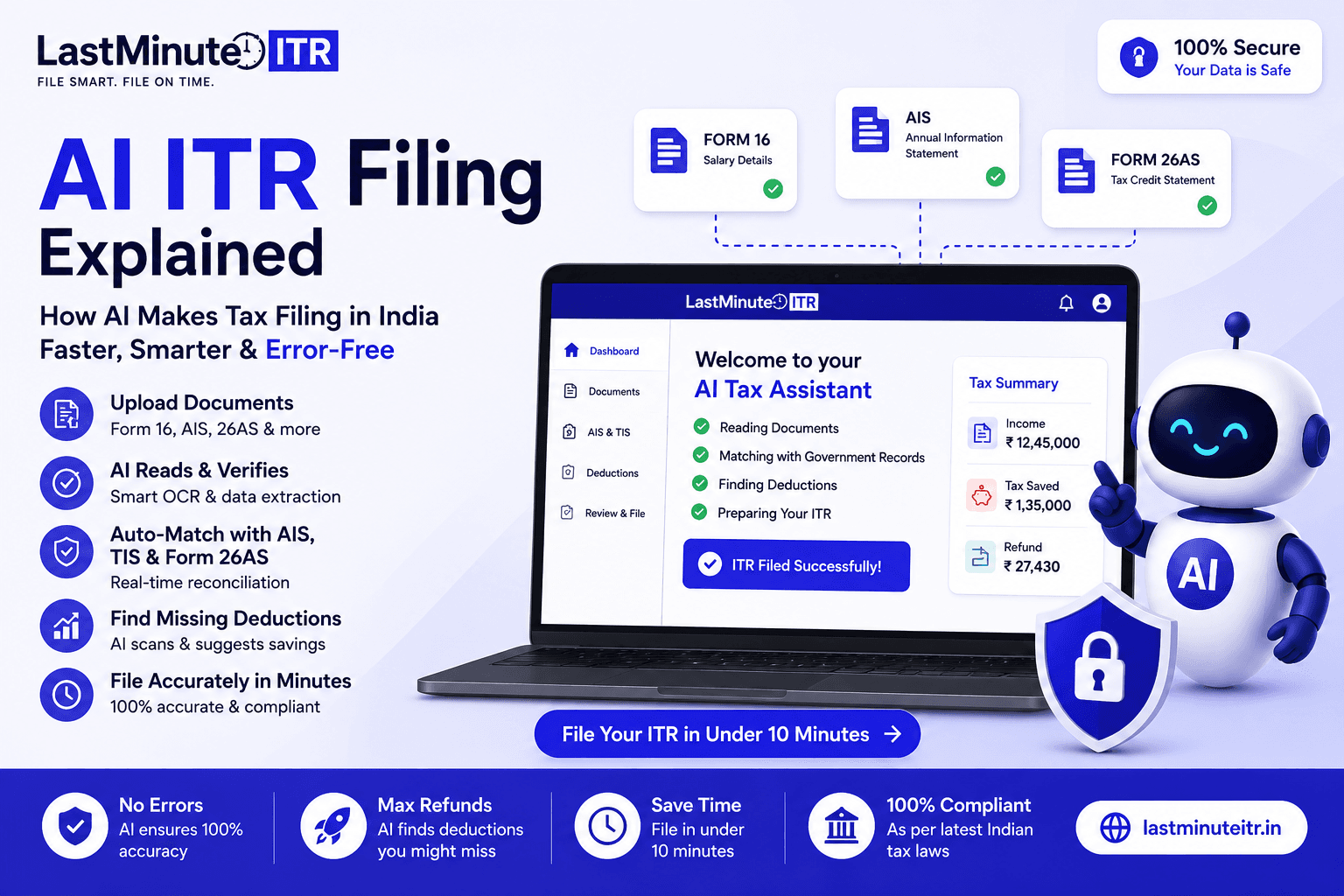

Filing an Income Tax Return (ITR) in India has historically been viewed as a stressful, jargon-heavy compliance ritual. For decades, taxpayers had to navigate confusing legacy portals, manually calculate complex exemptions, and map income fields line by line into rigid government utility sheets. One single typo could result in a dreaded tax notice from the Income Tax Department.
However, the digital landscape has fundamentally shifted. For the Assessment Year (AY) 2026-27, manual data entry is rapidly becoming obsolete thanks to the emergence of automated compliance software. But what exactly is AI ITR filing, and how does it transform the way we handle our taxes?
Let’s break down the core mechanics, technology, and systemic workflows behind this massive fintech shift.
The Evolution: From Legacy Portals to Smart AI Assistants
To understand the immense value of a modern AI tax assistant, it helps to look at how far the Indian e-filing ecosystem has come over the last few years.
The Manual Era (Pre-2020)
Taxpayers had to manually extract figures from physical or digital Form 16s, calculate capital gains using offline Excel spreadsheets, and manually fill out ITR-1 or ITR-2 Java/JSON utilities. The process required deep tax knowledge, and the room for human error was massive.
The Pre-Filled Era (2021–2025)
The Income Tax Department's portal began pulling basic salary and TDS data into the system. However, users still had to manually cross-reference, validate, and troubleshoot massive data mismatches with their Annual Information Statement (AIS) and Form 26AS.
The AI-Driven Era (2026)
Modern AI tax software India platforms act as entirely autonomous financial compliance engines. Instead of a user searching for where to input data, an intelligent system completely ingests your financial profile, flags missing deductions, reconciles data points, and structures the AI income tax return automatically without manual intervention.
How AI ITR Filing Works: The Core Mechanism
An AI ITR filing system doesn’t just guess where your numbers go; it relies on highly precise computer vision, machine learning models, and dynamic data parsing systems. Here is exactly what happens behind the screen when you upload your financial data:
1. Optical Character Recognition (OCR) & Document Ingestion
When you upload a PDF of your Form 16, capital gains statement, or home loan interest certificate, the AI doesn't just treat it as a flat image or text document. Advanced OCR algorithms instantly scan the document, identify key text patterns, and isolate financial figures.
The system can instantly distinguish between Part A (TDS details collected by your employer) and Part B (Calculations of Total Income) of a Form 16, eliminating human data-entry errors entirely.
2. Algorithmic Data Mapping and Schema Integration
The Indian Income Tax Department processes returns using highly specific digital architectures called JSON schemas. Every tax field—from Section 10 exemptions (like HRA or LTA) to Section 80C deductions—has a precise code and structural requirement.
Modern AI tax software India features pre-programmed algorithmic mapping. The moment the software extracts a data point, it automatically maps it to the exact required line item in the target ITR schema.
[Uploaded Document (PDF)] ──> [OCR Text Extraction] ──> [AI Mapping Engine] ──> [Official Government JSON Schema]
3. Real-Time Reconciliation Engines
One of the core components of an AI ITR filing platform is its ability to communicate with multiple secure financial endpoints via APIs. The AI pulls your live data directly from:
- Form 26AS (Tax Credit Statement)
- AIS / TIS (Annual Information Statement / Taxpayer Information Summary)
- Integrated Investment Portals (Direct broker connections for stock, mutual fund, and crypto transactions)
The engine runs a line-by-line reconciliation matrix. If your broker data says you made a specific amount in short-term capital gains, but your AIS shows a slightly different figure, the AI instantly flags the anomaly before you file, protecting you from automated tax notices.
Key Benefits of Using an AI Tax Assistant
Switching from a traditional manual filing process to an AI tax assistant offers significant operational advantages for regular taxpayers, freelancers, and business owners alike.
Elimination of Human Processing Errors
Manual typing mistakes are the leading cause of defective tax returns in India. AI removes this variable completely by reading direct data inputs and performing math with absolute computational perfection.
Optimized Regime Selection
With the continuous changes to the tax slabs in India, calculating whether the Old Tax Regime or the New Tax Regime saves you more money can be incredibly confusing. An AI income tax return platform runs simultaneous simulations of your entire income profile through both systems in milliseconds, presenting you with the most financially optimal choice.
Instant Identification of Missed Deductions
Advanced machine learning algorithms don't just process what you give them; they look for patterns. If the AI detects a regular monthly transaction that resembles rent but notices you haven't claimed House Rent Allowance (HRA), it will actively prompt you to check if you are eligible for the deduction.
Is AI ITR Filing Safe and Secure?
Data security is a primary concern when dealing with sensitive financial documents like PAN cards, bank accounts, and salary details. Legitimate AI ITR filing platforms operate under strict regulatory frameworks to ensure your data is heavily guarded:
- ERI Authorization: Reputable platforms operate as authorized e-Return Intermediaries (ERIs) registered directly with the Income Tax Department.
- Bank-Grade Encryption: Data transmission between your device, the AI software, and the government servers is encrypted using advanced AES-256 bit protocols.
- Data Minimization: True AI tax assistants only read data required to populate the tax fields and do not store or sell your personal financial profiles to third-party lenders.
The Future of Automated Compliance in India
The landscape of AI ITR filing is rapidly evolving beyond just a once-a-year tool. Moving forward into 2026 and beyond, we are seeing the rise of continuous tax planning.
Future systems will connect directly to your monthly accounting software or banking feeds to calculate your advance tax liabilities in real-time, ensuring you never face interest penalties under Section 234B or 234C. Furthermore, as the Income Tax Department transitions to faceless assessments, AI tools will be instrumentally vital in reading notices and draft-generating perfect algorithmic replies.
Conclusion: Emitting Manual Hassle for Good
Automated tax submission is no longer a futuristic concept—it is the safest, fastest, and most efficient way to ensure your taxes are calculated with mathematical precision. By removing human error from schema mapping and data entry, AI ensures you maintain perfect compliance with the latest Indian tax laws.
To learn how to seamlessly leverage these smart tools, read our complete guide to AI income tax filing India to optimize your tax regime, claim hidden deductions, and file your return securely in under 10 minutes.